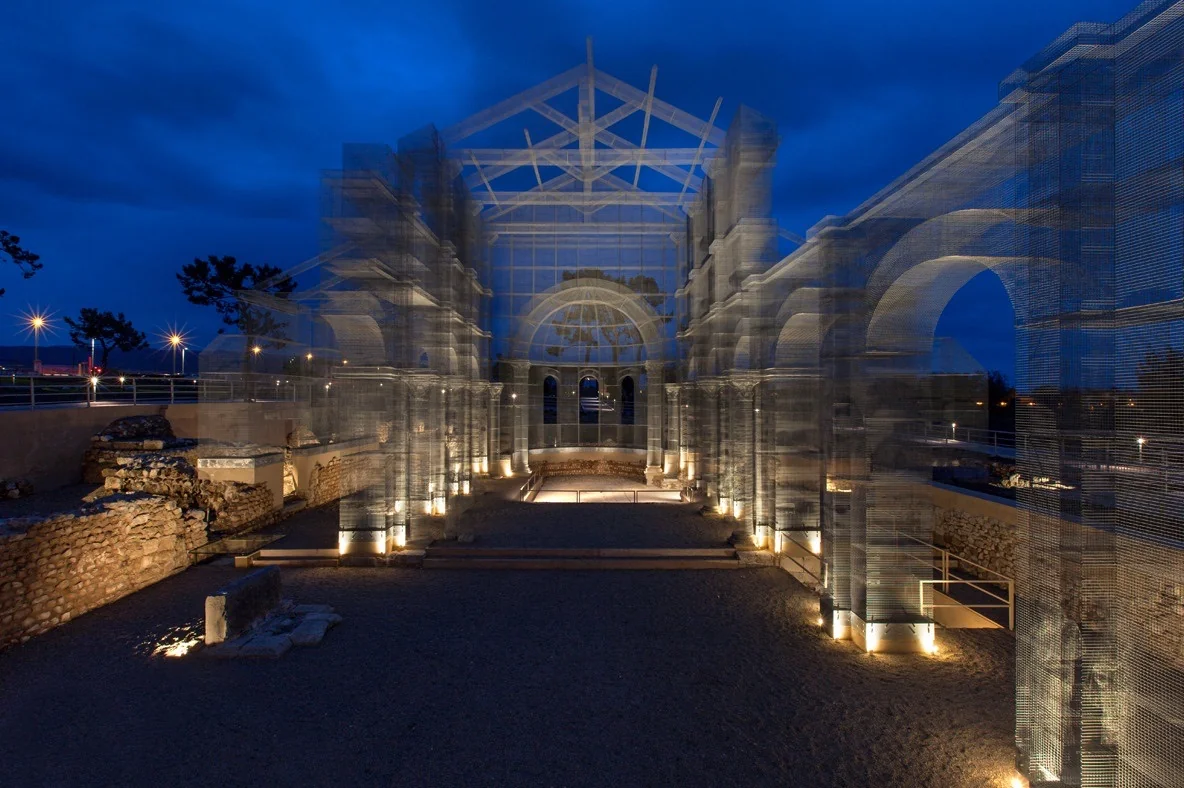
Some places change the way you feel. The Basilica of Siponto is one of them. Three kilometres from Manfredonia — five minutes by car from Casa e Bottega — among gnarled olive trees and the faint smell of salt air, you'll find a 5th-century church partly carved from bedrock and, above it, a cathedral of wire mesh that doesn't exist but does. It's architecture, memory, art, spirituality all at once. It's the only place where we at Casa e Bottega have seen non-believers weep.
Siponto: a city that vanished
To understand the Basilica of Siponto, you have to understand the city that is no longer there. Siponto was a Roman city — founded as a colony in 89 BC — and before that a Messapian port. It had its baths, its amphitheatre, its walls. It was one of the key stops on the Via Traiana, the road linking Benevento to Brindisi. For centuries it was one of the most active ports on the southern Adriatic, an embarkation point for the Holy Land during the Crusades.
Then came the earthquake of 1223. It wasn't the first — the area had been struck multiple times — but it was the decisive one. The city was abandoned. Frederick II of Swabia, who had just consolidated his hold on the Holy Roman Empire and was building his castles across Puglia, ordered a new city to be founded nearby: Manfredonia, later renamed after his son Manfredi. The inhabitants of Siponto were relocated. The old city remained, with its stones and its basilica, staring out to sea.
Today almost nothing survives of ancient Siponto except this: the basilica and the silence. But that silence has a particular density — eight hundred years of abandonment, broken only by the pilgrims who kept coming.
The early Christian Basilica — the stone heart
The Basilica of Siponto is one of the most important early Christian sites on the Adriatic coast. Built in the 5th century, when Siponto was still a thriving port on the route to the Levant, the church was partly carved from the rock itself. The columns are rough, the capitals simple, the original frescoes almost gone, but the cross-shaped floor plan is perfectly readable. Inside these walls, for fourteen centuries, people have prayed.
The building was modified over the centuries — especially in the medieval period — but it still retains the original three-nave structure with apse. The ancient floor is partially visible, with traces of mosaic. The thick local stone walls maintain an almost constant temperature year-round: cool in summer, less cold in winter. As if the rock were storing the warmth of every prayer it has absorbed.
Edoardo Tresoldi's installation — memory made of mesh
In 2016 the Italian Ministry of Culture commissioned artist Edoardo Tresoldi with an unusual task: to visually bring back to life the medieval church that once stood above the early Christian basilica. Tresoldi, who had already experimented with wire mesh as an expressive medium in other projects, proposed something radically different from a traditional reconstruction.
His solution was a cathedral of wire mesh — iron wire woven into arches, columns, apses — that reconstructs the volume and proportions of the vanished church without pretending to be stone. It isn't a replica; it's an interpretation of absence. Close up, the mesh is almost transparent: you can see through the walls, the sky through the vault, the trees through the windows. From a distance, it reads as a solid, majestic mass in dialogue with the Gargano landscape.
The work is titled simply "Basilica di Siponto" and in 2017 won the Special Jury Prize at Milan's Fuorisalone. At night, when the installation is lit up, the phantom cathedral stands against the sky like a dream in stone — or like the memory of something that was there and no longer is, but somehow keeps existing.
The best time to visit Siponto
If you can, visit Siponto twice: once during the day, once after sunset. By day, under the clear Gargano sky, you'll see how light works with the wire mesh — shadows move across the walls like a sundial, and the whole installation changes appearance hour by hour. Bring a camera, but know that no photograph really does justice to the experience of standing inside the structure.
In the evening, once the basilica is lit up, the mesh cathedral becomes something else entirely. The wire almost disappears into the darkness and what remains visible is pure form: arches, vaults, columns of light. It's one of the few places in southern Italy where public art and landscape genuinely speak to each other.
Spring and autumn are the best seasons — mild temperatures and fewer visitors. Summer is beautiful too: the Siponto dawn, with the sea behind you and raking light across the installation, is worth a five o'clock alarm.
Spirituality without religious denomination
An architect before Tresoldi's work thinks about the geometry of space. A photographer thinks about the composition of light. A believer thinks about the memory of martyrs and past pilgrims. A non-believer... simply stands in silence. Siponto is one of the few places where sacredness is a quality of the space itself, not an imposition of religion. You don't need to believe in anything to feel that something important happened here — and keeps happening.
Small details, great meanings
Notice the rocks around the basilica, worn by time and by the hands of thousands of visitors. Notice how the wire mesh threads catch the wind and transform it into a subtle sound, almost a breath. Notice the dampness inside the basilica, the cold that persists even in summer — the same temperature these walls had when they were part of a living city. These small details are why Siponto stays in the mind long after you've left.
Frequently asked questions about Siponto
What is the Basilica of Siponto?
The Basilica of Siponto is a 5th-century early Christian church located in the area of the ancient Roman city of Siponto, about 3 km from Manfredonia. It is one of the oldest places of worship on the Adriatic coast and is home to Edoardo Tresoldi's famous wire mesh installation.
Who is Edoardo Tresoldi?
Edoardo Tresoldi is an Italian artist and sculptor born in 1987, known for wire mesh installations that reconstruct vanished architecture. His work at Siponto, created in 2016 and unveiled in 2017, won the Special Jury Prize at Milan's Fuorisalone and received international recognition.
How do you get to Siponto from Manfredonia?
Siponto is about 3 km from the centre of Manfredonia — a 5-minute drive along the SP53. It is also reachable by bicycle on the flat coastal road (around 15 minutes) or on foot in 35–40 minutes. Easy to reach from Casa e Bottega in any direction.
Is the Tresoldi basilica always open?
The outdoor area of the Basilica of Siponto is accessible during daylight hours. The installation is lit up in the evening and visible from outside at night. Interior access and opening hours may vary — check the Polo Museale della Puglia website before your visit.
Is there an admission charge to visit Siponto?
Access to the outdoor area of the Basilica of Siponto is free. Guided tours inside or special events may require a ticket. Tresoldi's installation is visible from outside at no charge at any time of day.