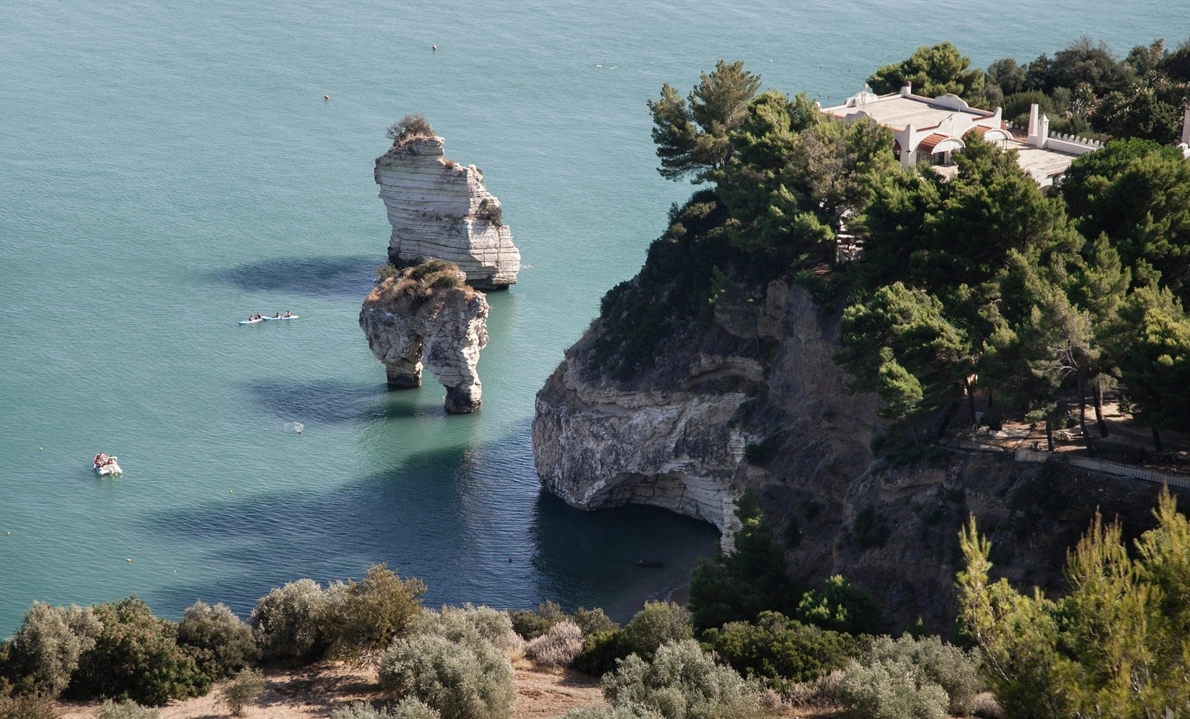
The Gargano is not only fine sandy beaches and rows of sun-loungers. Above all, it is a coastline of white limestone that plunges into the Mediterranean forming sheer cliffs, sea caves lit from within, and hidden coves accessible only by boat or along paths few people know. At Casa e Bottega we have lived in Manfredonia all our lives, and every summer we still discover something new along this coast. This article is our guide to the Gargano's cliffs: the most beautiful ones by name, how to reach them, where to snorkel, and how to organise a boat trip.
The geology of the promontory: an island that became a peninsula
Before talking about beaches and coves, it is worth understanding why the Gargano's cliffs are so different from the rest of Puglia. The Gargano promontory is geologically alien to the surrounding Puglian plain. Millions of years ago it was a limestone island, separated from the mainland by an arm of the sea that has since become the Foggia plain. Over the Pleistocene, alluvial sediments filled the strait and the Gargano became "glued" to the Italian peninsula, but it retains its insular nature: compact limestone, quite different from the soft tufa of the rest of Puglia.
This brilliant white limestone is the raw material of the cliffs. It is porous, reacts with seawater, and sculpts itself into forms no other rock produces: natural arches, caves, isolated sea stacks, deep channels between vertical walls. The light that bounces off the limestone and then off the water creates the colours you see in photographs — that impossible blue-green that looks digitally enhanced but is simply real.
The most beautiful cliffs by name
Baia delle Zagare
The most photographed spot on the Gargano, and deservedly so. Two twin sea stacks rise from the sea in front of a pebble beach accessible only by boat or down 400 steps from the road above. The name "zagare" comes from the bitter-orange blossom: according to tradition, zagara bushes once perfumed the paths leading to the bay. The fragrance has stayed in the name. The bay is in the municipality of Mattinata, about 40 km from Manfredonia. The footpath starts from a car park on the SP53; the descent takes about 20 minutes. By boat it takes 30–40 minutes from Manfredonia.
Vignanotica
Perhaps the most beautiful cove on the Gargano for those seeking solitude. White pebble beach, turquoise water, high cliffs all around. The walk in takes about 45 minutes along an unmarked trail from a car park on the main road — with around 200 metres of descent. Not suitable for young children or those unaccustomed to hiking. By boat it is much simpler: boat trips from Manfredonia and Vieste always include it.
Baia di Campi
More accessible than the others, it has a fine-gravel beach and transparent water. Its main feature is the sea cave that opens in the cliff to the right of the beach: you enter swimming or by kayak. The water inside the cave changes colour depending on the time of day — emerald green in the morning, bright blue in the afternoon. It is a few kilometres from Mattinata, reachable by boat or along a coastal trail.
Cala delle Sirene (near Manfredonia)
Less famous than the others, but for us at Casa e Bottega it is the most dear. It lies a few kilometres from Manfredonia harbour, along the coast towards Siponto. It is a small rocky inlet, almost always empty even in August, with shallow sea-beds ideal for families with children. The name comes from a local legend that sailors returning from long voyages heard singing coming from this cove on full-moon nights.
Sea caves: the hidden retreats of the coast
Grotta Smeralda and Grotta Campana are two of the Gargano's most visited caves. Grotta Smeralda takes its name from the colour of the water inside: a surreal emerald green, caused by light reflecting through a submerged opening. It is accessible only by boat. Grotta Campana, larger, has an opening wide enough for small boats to enter. The Architiello di San Felice is a natural rock arch carved by the sea over millions of years — perhaps the most recognisable symbol of the Gargano coast.
Boat trips from Manfredonia and Vieste
The most convenient — and often the only — way to see the most beautiful coves is by boat. Daily excursions leave from Manfredonia throughout the summer, generally June to September. Standard trips last 4–6 hours and include stops for swimming at three or four different coves. The indicative price is 30–50 euros per person, with lunch or aperitivo included in some packages. From Vieste, trips are more numerous and head towards the north coast of the promontory (Baia delle Zagare, Pugnochiuso), while from Manfredonia you cover the southern coast and the caves around Mattinata better. Book at least 2–3 days in advance in July and August.
Snorkelling on the Gargano: families vs advanced swimmers
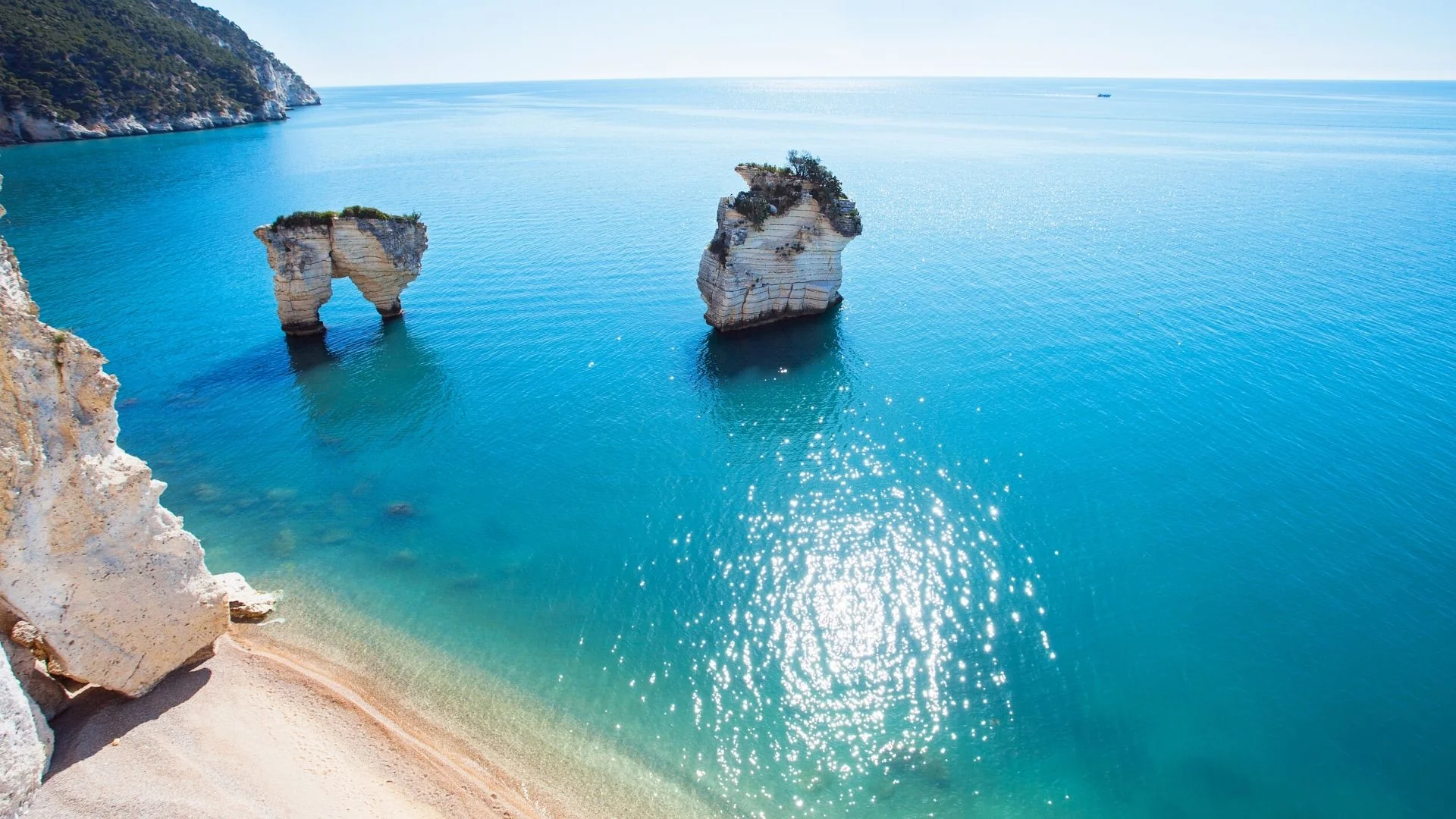
The Gargano is one of the best snorkelling spots in Italy, thanks to the combination of transparent water and rocky sea-beds teeming with life. Families with children will find the best conditions in the sheltered inlets near Manfredonia and Siponto, where the water is shallow and very calm. Bring fins, mask and snorkel, and look for rocky areas: there you will find purple sea urchins, starfish, small octopuses changing colour, and moray eels peering from their dens.
More experienced snorkellers will find the best conditions near the sheer cliffs, where the sea-bed drops quickly and marine life is richer. The areas around Baia delle Zagare and Vignanotica are particularly rich: grouper, conger eels, schools of sea bream. Watch out for currents: they can be strong near the cliffs and change direction suddenly. Always swim in pairs and do not stray too far from shore.
Practical tips for exploring the cliffs safely
Limestone is beautiful but unforgiving. Its edges are razor-sharp, it is friable where most exposed to erosion, and currents near the cliffs are unpredictable. A few rules we always follow: stay away from the edge of sheer cliffs; wear water shoes — the sea-bed is uneven and sea urchins hurt; go early in the morning (before 9) or late afternoon (after 17) for better light, less heat and fewer people; always carry plenty of water — the most beautiful coves have no bars.
Frequently asked questions
If you have more time, our 7-day Gargano itinerary will help you plan a full week from Manfredonia — beaches, villages, forests and the Tremiti Islands.
What are the most beautiful cliffs on the Gargano?
The most spectacular are Baia delle Zagare (twin sea stacks), Vignanotica (most secluded cove), Baia di Campi (with a sea cave) and Cala delle Sirene near Manfredonia. Each has a different character: some reachable on foot, others only by boat.
Can you snorkel on the Gargano?
Yes, the Gargano is one of Italy's best snorkelling spots. In July the water is transparent to 10 metres. Rocky sea-beds near the cliffs host octopus, moray eels, grouper and starfish. For families with children, the sheltered coves near Manfredonia are recommended.
How do you reach the hidden coves of the Gargano?
The most beautiful coves are reached by boat (from Manfredonia or Vieste) or on foot along coastal trails. Some require a short swim. Boat excursions are available June to September and should be booked in advance in high season.
Are there boat trips from Manfredonia harbour?
Yes. Daily excursions depart from Manfredonia towards the sea caves and coves of the promontory. Duration is usually 4–6 hours, indicative cost 30–50 euros per person. Book 2–3 days in advance in July and August.
When is the sea at its best on the Gargano?
The sea is at its best between June and September. July and August offer maximum clarity but most crowds. June and September are ideal: water still warm (24–26°C), fewer people, lower prices.