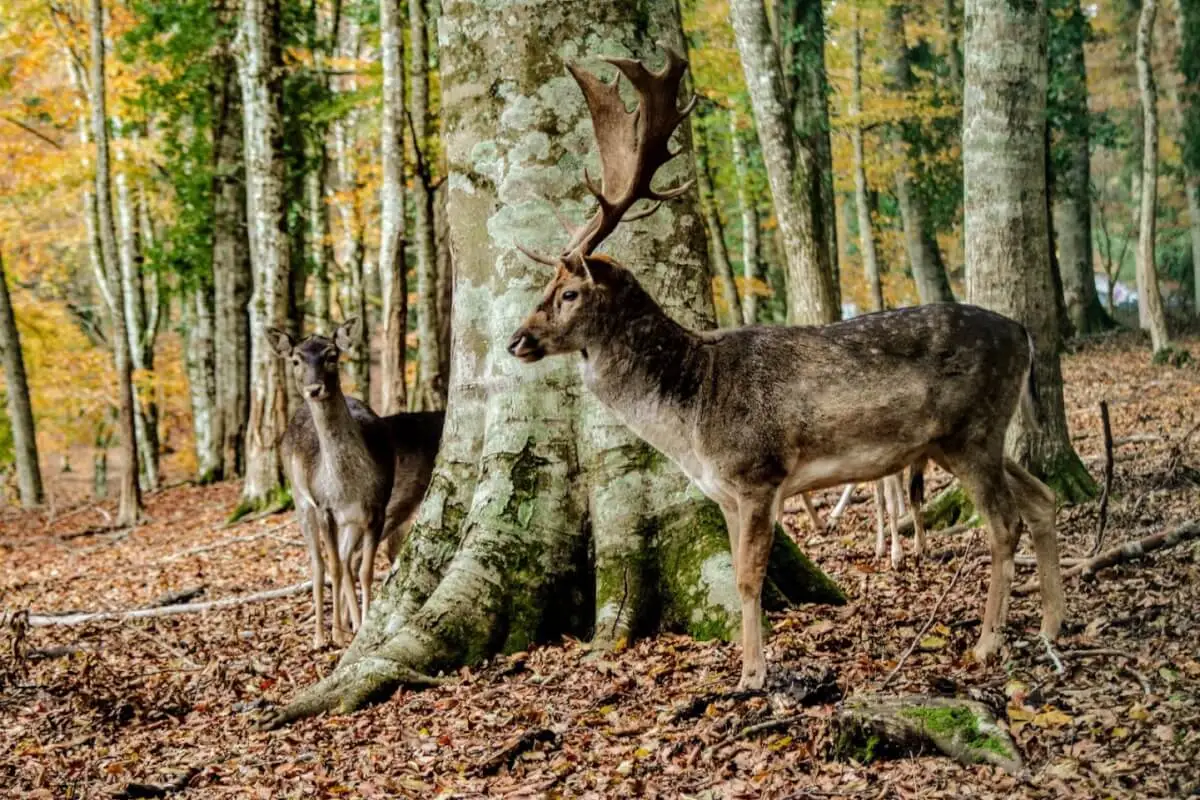
Those who know the Gargano only from the sea have no idea that at its centre lies a forest that seems to belong to another continent. While down on the coast the sun beats on white cliffs and the asphalt burns underfoot, up here the beeches have cast their shade for centuries, the air is cool even in August, and every now and then, rounding a path, you come face to face with a fallow deer that just looks at you without running away.
Foresta Umbra is the green heart of Gargano National Park: 10,000 hectares of mixed woodland dominated by beech, with holm oaks, limes, maples and yews growing together as in few other places in southern Italy. It is a relic of the Ice Age, a forest that existed here before human settlement on the promontory. It is protected, maintained, walkable on foot or by bike, and every summer it saves thousands of people from the relentless heat of the coast.
The deer: the spectacle you never expected
Nobody says it clearly enough, so we will: in Foresta Umbra the fallow deer are everywhere, and they are not afraid of you. These are not deer in an enclosure — they are animals living free in the woodland that have learned over the years that visitors pose no threat. The result is one of those rare encounters between human and wild that stay with you.
You find them especially in the clearings near the visitor centre and along the paths descending towards Vico del Gargano. They graze among the trees, stop to look at you and carry on. In August the males already carry their full antlers — the branched rack they will use in the autumn rut. Close-up photographs are possible without a telephoto lens.
The best time to see them is at dawn or in the late afternoon: in the middle of the day they retreat into denser undergrowth to escape the heat. If you reach the visitor centre by 8 am in summer, the chances of finding a group in the clearing are very high. Move slowly and quietly.
The trails: finding your way in the forest
Foresta Umbra has a network of marked trails starting from the visitor centre. Routes are well maintained with orientation boards and colour-coded waymarkers.
Beech Trail (2.5 km loop): the basic route, suitable for everyone, through the densest beech wood. The oldest beeches here have trunks over one and a half metres in diameter — trees several hundred years old, and they look it.
Springs Trail (4 km loop): climbs slightly towards the north-facing slope where small springs emerge. Less busy, quieter, and better for wildlife — deer, roe deer, woodpeckers, jays. Wear proper shoes: the ground is uneven.
Panoramic route to Vico del Gargano (8 km, best by e-bike or as a full day): drops towards the northern slope with views over the Gulf of Manfredonia and the Tremiti Islands on clear days.
E-bikes and refreshments: Hotel Elda
For those who want to explore the forest without exhausting themselves — or simply cover more trail kilometres — Hotel Elda offers e-bike hire right at the entrance to Foresta Umbra. It is the ideal solution for families, for those who want to tackle the longer routes, or simply for anyone who prefers to pedal with a little electric assistance over the woodland climbs and descents.
Hotel Elda is also the main refreshment stop for forest visitors: a place to stop for lunch, a coffee, or to catch your breath after the trails. Find rentals and services at eldahotel.it. In high season it is worth booking e-bike hire a day in advance — bikes sell out fast at weekends.
August in the forest: why it beats the beach
There is a paradox the locals know well: while the beaches of Vieste and Peschici are packed and Manfredonia's seafront swarms with people, Foresta Umbra is quiet. The forest absorbs everything — sounds, crowds, heat. Under the beeches it is 10–15 degrees cooler than on the coast, the air smells of damp earth and resin, and the silence is the real kind — not the silence of empty places but of places full of quiet life.
Autumn: the foliage few people know about
If August is the most popular time, October and November are the most beautiful. The beeches of Foresta Umbra turn red, orange and gold in one of the most striking autumn displays in southern Italy — a landscape you would not expect at this latitude. Misty October mornings, with low light filtering between the pale beech trunks and leaves falling, are something photographers who discover it return to shoot every year. In autumn the forest is almost deserted: the deer are more active as the rut begins, and you may hear the males bellowing in the early morning.
Foresta Umbra and Manfredonia: a full day out
The drive from Manfredonia to Foresta Umbra is about 70 km — just over an hour. Our suggestion: leave by 7:30 am to arrive at opening time, spend the morning on trails spotting deer, have lunch at Hotel Elda, then head back via Vieste or drop down to Mattinata for a last swim before sunset. The full 7-day Gargano itinerary we wrote is built on exactly this principle: always have an alternative at hand.
Frequently asked questions about Foresta Umbra
Where is Foresta Umbra?
Foresta Umbra is in the heart of Gargano National Park in Puglia, between Vieste, Vico del Gargano and Monte Sant'Angelo. It is about 70 km from Manfredonia (one hour by car) and about 25 km from Vieste.
Do you really see deer in Foresta Umbra?
Yes, with good probability. The fallow deer live semi-wild and approach visitors fearlessly in the clearings near the visitor centre. Best time is dawn or late afternoon, moving slowly and quietly.
How do you hire an e-bike for Foresta Umbra?
Hotel Elda, at the forest entrance, offers e-bike hire and a refreshment stop. Book ahead in high season at eldahotel.it — bikes run out fast at weekends in August.
When is the best time to visit Foresta Umbra?
August for the cool shade versus the coastal heat; October–November for the beech foliage, one of the finest autumn displays in southern Italy. In both cases, arrive early for the best chance of seeing deer.
How long does a visit to Foresta Umbra take?
At least 3–4 hours for a proper visit with a trail and a stop at the visitor centre. With e-bikes you can cover more ground. Combined with the coast, it makes a full day out from Manfredonia.