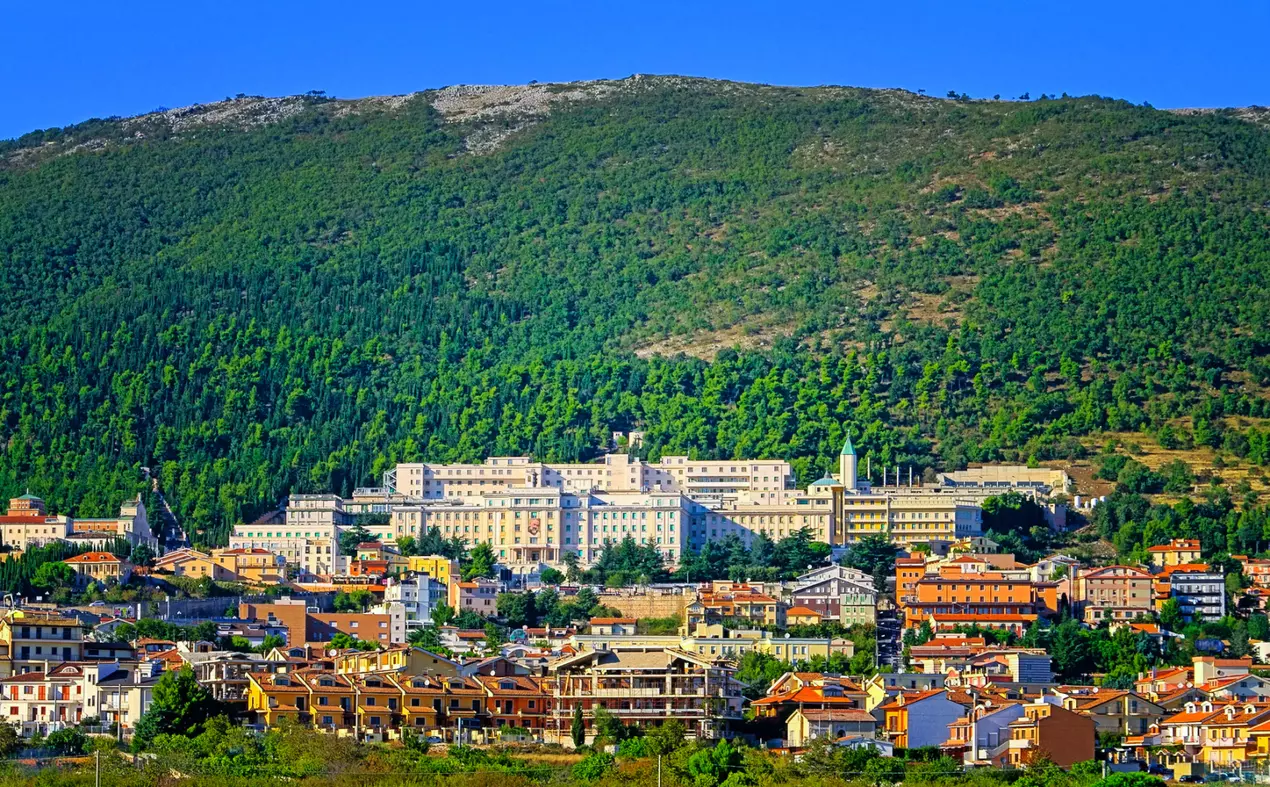
There are three places on the Gargano where the sacred has left a mark you can still feel in the air: the basilica of Siponto, the sanctuary of Saint Michael at Monte Sant'Angelo, and San Giovanni Rotondo, the town of Padre Pio. They are the three corners of an ancient spiritual triangle, and from Manfredonia you can reach them all in under an hour. San Giovanni Rotondo, in particular, is today one of the most visited sanctuaries in the world: millions of pilgrims arrive every year, from every continent, for a Capuchin friar who turned a mountain town into a destination that rivals Lourdes or Fátima.
You don't need to be a believer to be moved. San Giovanni Rotondo brings together popular faith, contemporary architecture of the highest order, and a human story — that of Padre Pio — that weaves together mysticism, suffering and an idea of charity that became one of the most important hospitals in southern Italy.
Who was Padre Pio
Francesco Forgione was born in Pietrelcina, in the province of Benevento, in 1887. He entered the Capuchin order very young, taking the name Fra Pio, and in 1916 he arrived at the friary of Santa Maria delle Grazie in San Giovanni Rotondo, where he would remain until his death in 1968. In 1918 — according to tradition — he received the stigmata, the wounds of Christ's passion, which stayed with him for fifty years and made his name famous throughout the world.
A vast devotion formed around him during his lifetime, made of long queues at the confessional and accounts of healings. He was canonised by John Paul II on 16 June 2002, before one of the largest crowds ever gathered in Rome. Today he is simply Saint Pio of Pietrelcina, and San Giovanni Rotondo is the heart of his cult.
The old church of Santa Maria delle Grazie
The pilgrimage begins here, from the original core: the small church of Santa Maria delle Grazie and the Capuchin friary where Padre Pio lived, prayed and heard confessions for over half a century. It is the most intimate, gathered place in the whole complex. You can see the friar's cell, the choir where he received the stigmata, the confessional and the rooms that tell of his daily life, far from the monumentality of the more recent buildings.
It is the part many pilgrims love most, precisely because it has remained on a human scale. Coming early in the morning, before the coaches arrive, is the best way to take in its silence.
The new church by Renzo Piano
Next to the old sanctuary opens a completely different space. To welcome the millions of faithful the old church could no longer hold, one of the world's most celebrated Italian architects was called: Renzo Piano. The new church dedicated to Saint Pio of Pietrelcina was consecrated in 2004 and is one of the largest in Italy, able to hold thousands of people between its interior and the huge stepped forecourt that opens onto the Gargano landscape.
It is a bold piece of architecture, made of great arches of Apricena stone — the very stone of the Gargano — fanning outward. Whether or not you like the contemporary style, its power is undeniable. Beneath the church lies the crypt, clad in glittering golden mosaics: this is where the body of Padre Pio rests, and the point toward which the continuous flow of pilgrims converges.
Casa Sollievo della Sofferenza and the Via Crucis
Padre Pio was not only a mystic. His most concrete legacy is a hospital: the Casa Sollievo della Sofferenza (‘Home for the Relief of Suffering’), which he strongly willed and which was inaugurated in 1956. Born as a ‘hospital for the poor’ on a then-isolated mountain, today it is one of the most important research and care centres in southern Italy. It reveals a side of Padre Pio that often escapes notice: the idea that faith should translate into care of the body, not only of the soul.
On the hill behind the sanctuary climbs the monumental Via Crucis, an open-air path among large bronze stations set in greenery. It is a walk worth taking slowly, especially in the late afternoon, when the light softens and the Gargano landscape stretches all the way to the sea.
A route of faith: from Manfredonia to the three sanctuaries
The beauty of having a base in Manfredonia is that the Gargano's three great sacred sites all lie within half an hour to forty minutes, along the same road that climbs the promontory. A perfect one-day itinerary: set off early, first stop at the basilica of Siponto with Tresoldi's installation, just outside Manfredonia; then up to Monte Sant'Angelo, a UNESCO village with the grotto of Saint Michael; and finally, higher still, San Giovanni Rotondo. Three eras, three forms of spirituality, a single landscape.
To organise your travel and understand the distances and roads of the promontory, our guide on how to get around the Gargano can come in handy. And if you have more days, our one-week Gargano itinerary fits the sanctuaries together with the beaches and the seaside villages, keeping Manfredonia as your base camp.
When to go and a few tips
San Giovanni Rotondo can be visited all year round, but the rhythm changes a great deal. Spring and autumn are the quietest and most pleasant times. The dates linked to Padre Pio — above all 23 September, the anniversary of his death — draw enormous crowds: wonderful for those seeking the atmosphere of great popular devotion, tiring for those who prefer calm. In summer the sun beats down on the open forecourt: early morning is best.
One last tip: treat it as a place, not just an ‘attraction’. Even as a non-believer, lowering your voice, removing your hat as you enter the church and leaving room for those who are praying is part of the experience. It is what makes San Giovanni Rotondo different from any other stop on the Gargano. If you're in the area at Easter, Holy Week in Manfredonia offers the same sense of living tradition, just a few kilometres from the coast.
FAQ — San Giovanni Rotondo and Padre Pio
How far is San Giovanni Rotondo from Manfredonia?
San Giovanni Rotondo is about 40 km from Manfredonia. The road climbs the Gargano promontory, so the drive takes around 40–45 minutes. From Casa e Bottega it's an ideal day trip, easily combined with Monte Sant'Angelo.
What is there to see at Padre Pio's sanctuary?
You can visit the old church of Santa Maria delle Grazie, where Padre Pio celebrated Mass and heard confessions, the Capuchin friary, the large modern church designed by Renzo Piano, and the crypt with mosaics where the saint's body rests. The monumental Via Crucis also climbs the hill behind.
Is entry to the San Giovanni Rotondo sanctuary free?
Yes, entry to the churches and the crypt is free. As it is a place of worship, modest dress is recommended, with shoulders and knees covered, and silence during services. Opening hours vary by season: it's best to check them on the sanctuary's official website.
How do you get to San Giovanni Rotondo without a car?
From Manfredonia there are buses run by local companies (Ferrovie del Gargano and SITA) connecting the coast with San Giovanni Rotondo, often via Monte Sant'Angelo. In high season many agencies organise guided day trips from Manfredonia and nearby towns.
When is the best time to visit San Giovanni Rotondo?
Spring and autumn are the quietest. On the dates linked to Padre Pio — 23 September, the anniversary of his death, and feast days — the sanctuary is very crowded. In summer it's hot, and early morning is the best time to visit at a relaxed pace.